I feel like anyone who’s been following me this year will be dizzy from my back and forth; maybe they won’t be, but I am.
There’s been times where I’ve returned and announced that I’m, indeed, back. Then there’s been times I’ve ghosted you all for extensive amounts of time.
(I’ve been worse than a toxic partner and I’m sorry for that.)
Self-guilt holds me back.
The self-guilt that follows me about everything I do, every mistake I make, is eating this up and so I back away…
Maybe if I just don’t post – don’t try – maybe that’ll be better than failing?
Perhaps I’ll feel less like a burdening failure – as if it were ever that simple.
Now, you may be thinking “isn’t all this too serious?” and well… you’d be right if it really were as simple and uncomplicated as it seems.
Society weighs our worth by our productivity.
When you add that to the picture, it should become clearer…
Like many who can’t live up to that, it’s embedded the self-esteem of a blunt pencil into me.
My blog was one thing I could say “look what I’ve achieved” – be proud of (as much as I can be of something I’ve done, aha!) and stick one finger up at the judgement with.
Therefore, it’s hurt not to have it and the reason I haven’t hurts even more – it’s something my mind can blame me for legitimately and it likes that.
I have big ideas.
While it’s true this is a very rare available career option with my disabilities and health, I also adore writing and working to get pieces ready.
It’s something I’m really passionate about and, while it might take me longer than others, I greatly enjoy.
The truth is, I want to do this for a career and I can only do that if I don’t keep vanishing.
I have so many ideas for blog posts and articles and how I generally want this place to be. In fact, I have so many pieces written – whether finished or parts needing to be woven together.
I need to start having confidence.
One of my worst habits is writing things and not having the confidence to push them further; including to prepare them for publication.
In my drafts, I’ve written about some big topics: there’s a collection of ideas about the loneliness that comes with chronic illness; an essay on how the term “brave” is complicated with disability and all sorts of poems about mental illness, chronic illness, disability and queerness.
Don’t get me wrong, I’m as proud as I can be about them (again self-pride is… complicated) but I have niggles of doubt and, so, I don’t post them.
I tell myself I’m not “good enough.”
There’s tears in my eyes as I write this part and, at the same time, I feel stupid for it.
I was (don’t ask why I’m not still) in therapy for years, dealing with these things so I feel like I should be “over it” by now.
I know that’s far from the truth – I wonder if it’s part of my self-esteem to not think I’m doing “well enough” with that either.
No matter what, I’ve been told right from young I’m not good enough by the world at large and that definitely reflects itself in my work.
I write but I don’t post.
As I’ve always said, writing is my therapy and I’ll writeuntilthe day I can’t – even if it’s just two sentences here and a few words there.
In fact, I remember us finding an old notebook of mine and, although illegible, it showed how I’d always used writing – even before my letters looked like any alphabet.
There’s poems, stories and rants on pieces of paper from various points in my life and there’s some only god could know what they are.
Begging to be heard.
When my speech failed me (which, with speech difficulties and brain fog, was/is often), I turned to writing to get my voice heard.
Even in my medical notes, there’s a handwritten rant (with its text getting bigger and bigger due to my hand pain) from when I was 10 or 11.
It illustrates how little I felt heard and, after gaining my approval, my Mum sent it to everyone who it was appropriate to – including my school and GP.
I continue to write, I just don’t post.
Even though I don’t truly want to, I’ve just been keeping my work as drafts – even when they’re complete – because I don’t have that confidence.
I tell myself “what right do I have to discuss XYZ when there’s writers out there way better than me with much bigger voices?”
Then that becomes “I keep ghosting the platform I do have, what right do I have to talk about XYZ when I’m so bad at this?”
I need to stop this cycle.
I feel trapped and there’s only one way to break free of the cycle that locks me in chains: to fight the fears and self-criticism and just post.
It’s gonna be far from easy and there will be times I slip but I’m tired of the shackles I’m placing on myself. I’ve got so many already, I need to stop adding to them.
Of course, I don’t know how that will look like or how long it’ll take or how many setbacks there will be. But I do know that I’m determined to not let my lack of esteem keep holding me back.
As I’ve gotten older and developed as a person, my ideas for The Zebra With Rainbow Stripes have changed and developed too.
Today, I’m talking about that journey, its depths and where I’m planning to go with my blog (and beyond!).
Where it began
See, I started my blog when I was fourteen and felt like I didn’t have a voice. After five years of being near housebound, I had basically no social life or interaction with the outside world.
I had no friends my own age outside of family, I felt isolated and like I was the only person going through what I was because representation was seemingly always out of grip.
It began as a cry to be heard and seen by the world I felt invisible in. And I’m proud of that because, in a world that routinely tried to push me in a dark corner, I was still fighting to be seen and heard and respected.
At times, it felt easier to crawl into that dark corner. It felt inevitable I’d lose to it. It felt like a pointless fight I could never win.
Worse were the times it felt deserved because I was too much, too little, never simply enough.
Then, it shifted
That lonely 14-year-old screaming to be heard who believed they’d always live for others, not because they wanted to, grew up and felt a ray of sun on their face.
Step by step, I found myself (still continuing to), met friends online, felt more visible, realised it’s okay to need medication for the chemicals in my brain and relearnt what it feels like to want to live again.
I took a couple years mostly away from here. It wasn’t a choice but I’m glad I did as it gave me the space to realise who exactly I am and what I want from this life.
Without it, I fear I’d have continued trying to be who I thought I needed to be instead of just being me, in all my flawed beauty.
I wouldn’t have found my people in friends because I would have continued to hold parts of myself back and not been me.
What I want
Standing back from the blog made me realise what I wanted to post and talk about the most.
I realised it was the tricky, icky things people try to stay away from talking about or which I’ve feared judgement on.
It was all the things I felt/feel the most alone in while knowing deep down I couldn’t be.
I realised I want to build somewhere people know they’ll to find disability and/or queer representation, essays, guides, poems, recommendations, musings, videos and so much more.
A place I’d love to hang out if I was the reader and, eventually, span out with a child friendly area of The Zebra With Rainbow Stripes.
A place I’ve often needed and was never able to find.
It’s going to take time
The truth is, I have a whole lot of ideas and hopes and dreams. It’s gonna take a long time. Especially as I can only put a very small amount into achieving it.
When has that ever stopped me? For long, if at all? I’m not about to start letting it, either.
Some things might change over time, stop being so relevant, prove impossible for me to achieve.
Nevertheless, some will happen if I keep making small steps and maybe I’ll achieve things I have no idea about right now.
I’m stubborn and pig-headed
Sometimes it gets me into trouble; situations where I’m being bopped on the head with falling toilet roll and shouting for help.
But, if something to do with the moon aligning happens, it means I survive (quite literally at times). It has always taken me longer to do things but that also means that I’m more resilient.
It’s threatened by my self criticism and judgement, the way I bully and gaslight myself.
Some days I just curl up and cry.
Some days I feel worthless or like a failure.
Some days it seems as though I’ll never get anywhere because of the obstacles always in my path.
And, daily, those around me have to remind me of my worth.
But, nevertheless, my resilience is just that – resilient. Therefore, I’m sure that I’m going to achieve at least some of what I dream to. If I do things little by little then I’m sure I can accomplish little by little too.
Slotting everything together
I’ve been trying to figure out how it all slots into place like Ikea furniture. However, unlike a flat-packed table, I actually believe I have the ability to fit it all together. Even if it takes some duct tape, zip ties and WD40.
While I always loved to use them to represent the depths of a life with illness and disability, I realised that it doesn’t align with my current voice – the one I want to build – it doesn’t quite fit with its randomness.
It wasn’t that they were bad, I still love them richly, but they were for what the blog was and not what I want it to be.
So how do I piece random things – books, crafts, films, and more – into the bigger picture I envision?
Well, I’ve realised the base of everything I want to achieve is creating something that I didn’t have but needed, that my family needed while trying to navigate life where disability affected most things.
So, in my aim to create somewhere that has resources and lifts unheard voices, I want to make my rambles fit this tone.
I’m thinking lists of books with (positive) disability representation, playlists for Pride, favourite accessible apps, and reviews with disability and/or queer representation at the centre. (And more…)
Because I’m just one voice out of many but I am one voice and I’m gonna make it count like I personally want to.
Twenty. I am twenty. Two decades. It might be a long while until I get used to that. I used to think people in their twenties knew what they wanted in life, who they were and wanted to be and just knew stuff.
For once you treated me quite well letting life blossom just as the leaves fall sure you were ruthless too are you even capable of doing otherwise in this weird, troubled relationship between me and you? making dreams of old and new reality even long some’s hope had faded like an old photograph, restoration long overdue stained over time with troublesome liquid a decade after you began to be a foe perhaps you’re trying to set a redo it’ll never work but continue trying next year and the year after I plead one thing is for definite, so clearly true even an apology will take much work but one day maybe the hate won’t spew
Every time I go to write this post, I leave the page empty and back away. I want to say hi, I miss it here where it always feels nice and warm, with all of you. But something keeps holding me back from the words I have to say.
I’ve been reluctant about sharing my story of discovering my identity in this way, and that’s because of multiple reasons if I’m being honest.
Firstly, I’m very lucky – compared with too many others – to have my very supportive family, and therefore I keep telling myself that I shouldn’t tell my story as surely what I have to say won’t be as worth sharing in a way of helping others maybe?
Secondly, I don’t want it to be seen as anything more than a straight person’s sexuality would be and I’ve been worried that if I talk about it more than just in passing it will become so.
But, then I thought that I’d share it, because I had a gut instinct that I needed to. Also, I’m an advocate that everyone’s story holds much worth, as much as everybody does, so surely it would be wrong to continue with that?
As for the latter, I hope that it won’t as I’m thinking that it shouldn’t really do so; the story is about finding my identity as an LGBT+ member, and that is something which every LGBT+ member will hold.
I’ve spoken a lot about my love for books, I’ve even spoken here and there about how I read. For a question that I’ve been asked more times than I can count; how do I read with my sight impairments?, and a subject that I’ve wanted to fully cover for a while, it’s maybe a little strange that I never actually have.
The truth is though, I kept wondering whether I could even create an interesting-enough post for you all, my lovely readers.
Then, I thought; well it’s clearly a subject that interests people (I probably would’ve been interested before my sight loss, as it’s not just about the assumed audiobooks), it could turn out to be a useful post (at the least, I can point people to it when they ask…), and well – why shouldn’t I?
After all it’s not like I’m that harsh about interest usually, I guess it’s just because it’s such a subject that I desperately want to write really well because of all the questions that I’ve been asked about it, and that puts pressure on it.
If I let such a worry stop me then my blog would be a blank space -well it just wouldn’t exist at all – so why should this be different.
It’s like there’s this spilt between the majority of people’s belief when it comes to this subject; Blind/VI people can’t read, or we can only do so if we can use large text. Or at least, that’s what I’ve come across. And, that’s definitely not true.
Our visual impairments do not stop us from being able to read, and the latter is stark ridiculous; firstly, what about audiobooks? For something that was specifically made for the blind/VI, the ratio between questions about that and questions about how I can read is really – really – different.
I plan on writing a post – or perhaps a few – on audiobooks (and how they’re treated in today’s society) specifically at some point in the near future, however today’s post isn’t dedicated to them but all of the ways that I read and some apps that I use for reading, so I’ll leave that for now and continue with this post.
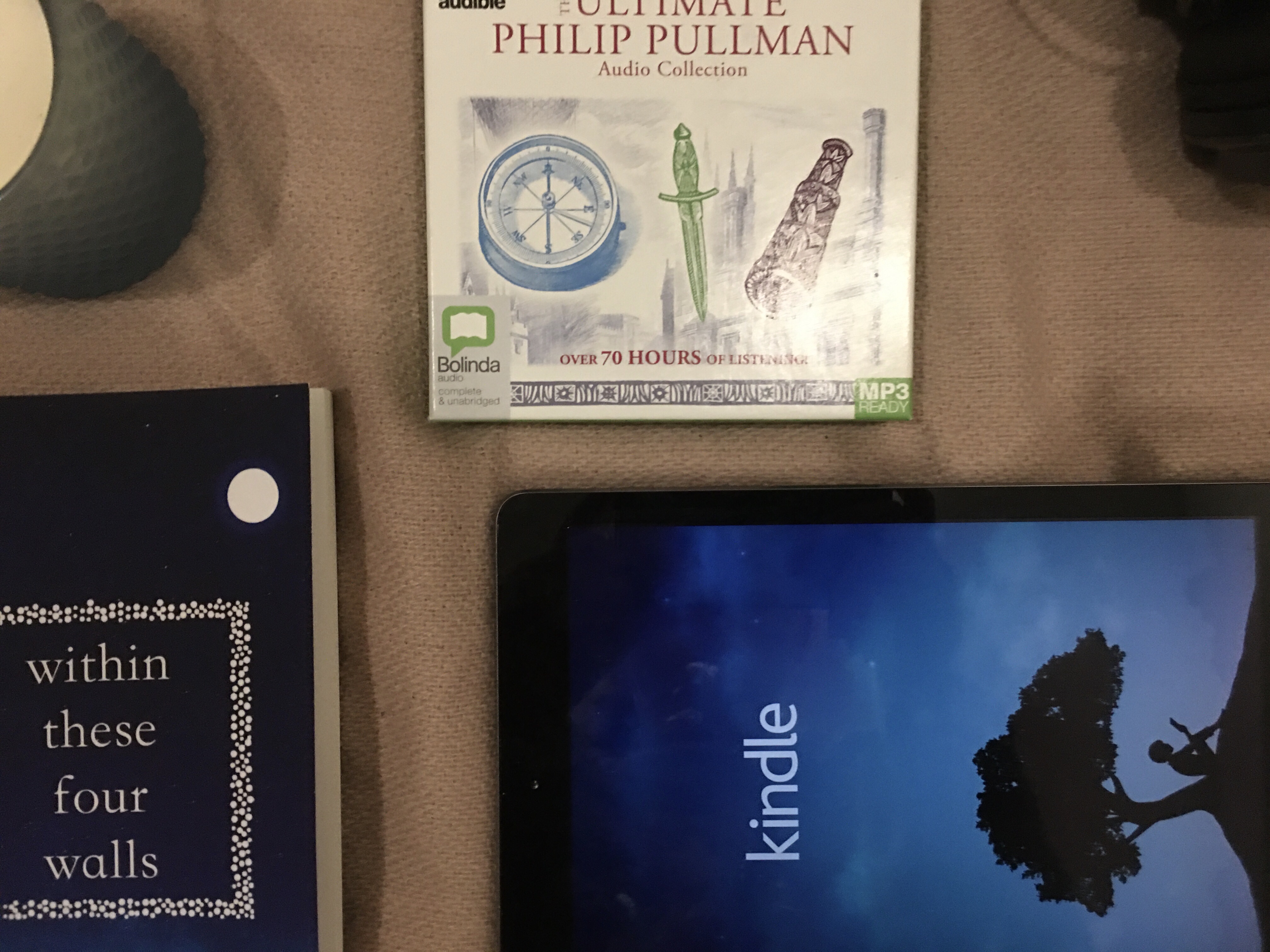
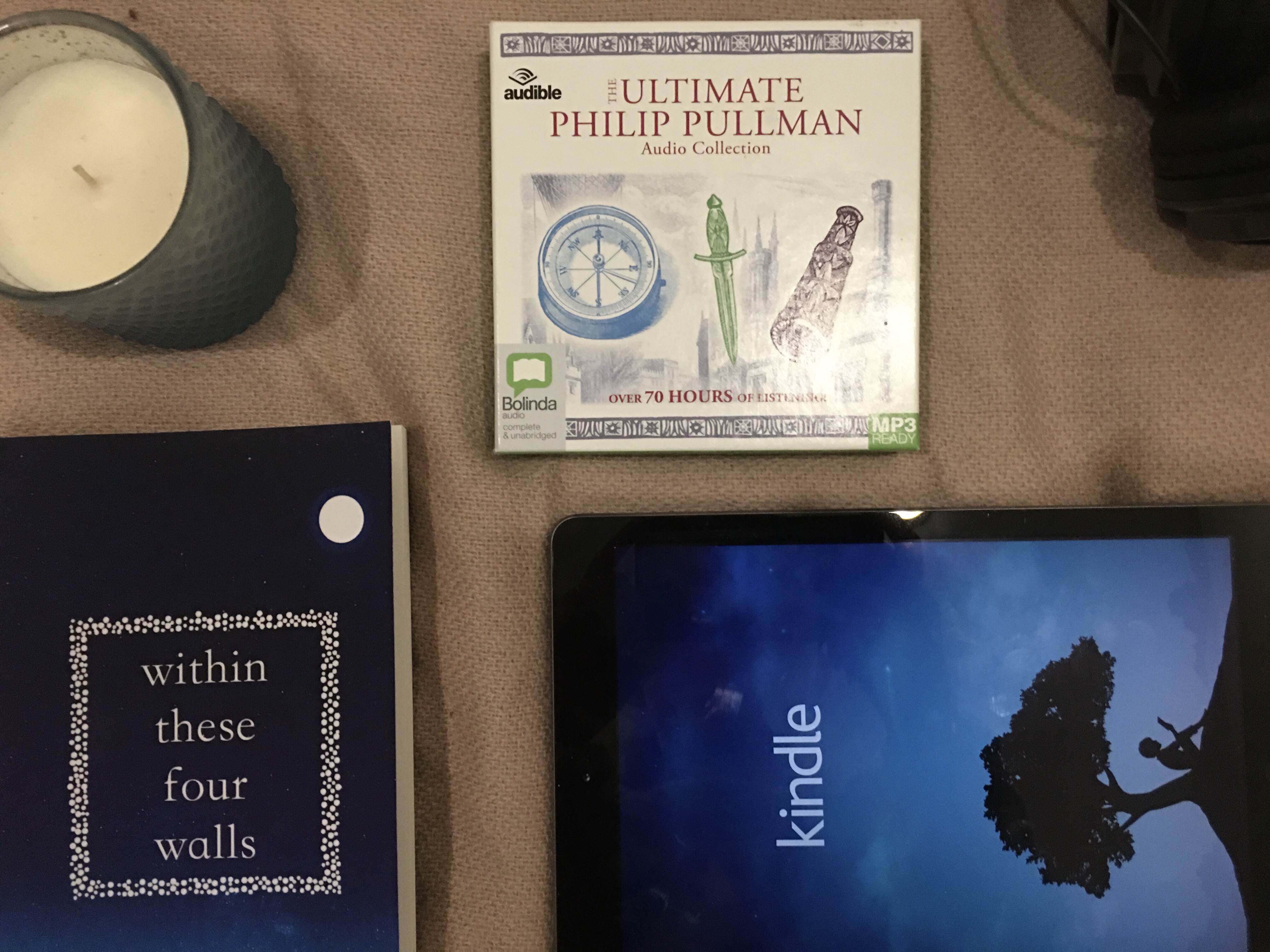
Kindle X Screen Reader.
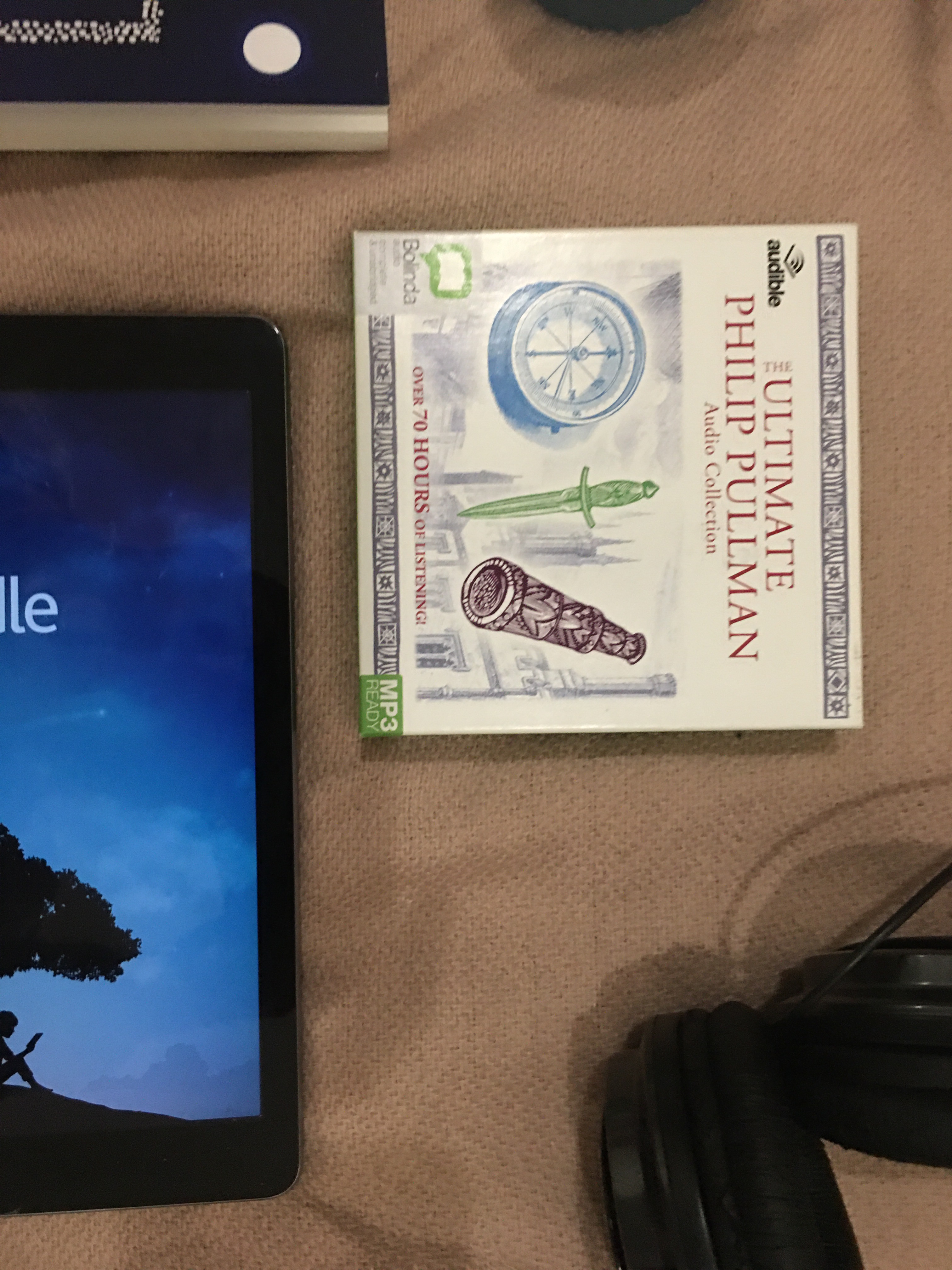
Thus, turning a kindle book into an audiobook – kind of. This is one of my most common used ways to read, as it’s one of my favourites.
By swiping down with two fingers – from the top of the screen to the bottom whilst an iOS screen reader is on – you make the command for it to “read all”; meaning that it will read all of what is on the screen.
When you use an app such as kindle and use this to read a book, it will keep reading (if you have the page-turning setting turned on) until either you tap the screen or the book finishes – depending on which happens first.
This is my favourite way to solo-read now, it’s quick, simple, and means that the reader is always a voice that I like as it’s my screen reader which I carefully chose; which means that it doesn’t distract me from the story being read.
Because of mine and my Mum’s illnesses, we – as a family – found that we needed the Prime service; going out is far from easy and we need the quick service, and so because we have it, we get Prime Reading; a free library of kindle books which you can rent up to ten books from for an unlimited amount of time.
I commonly use this service; I find that it introduces me to authors that I may not of known about or if I had, tried their books.
This works greatly on other ebook apps, I just use kindle much more than any other. I also don’t know if any other screen readers do this (the only other ones that I’ve tried have been terrible, so I didn’t try using them on ebooks) but I’ve heard of some seemingly-brilliant ones that probably do.
With A Family Member.
This is most commonly with my Mum, but when we have time to – it’s with my sister Rhianna as well.
I love these times, I always have. I love spending time with them, so being able to do this and talk about the books – without the fear of giving away any spoilers to my Mum or Rhianna (depending on who I’m reading with) about books that they may want to read, is one of my favourite things to do.
My mum and I read every day together, it’s this sweet tradition. Obviously, depending on who is reading, they read and I listen (before i lost my sight, we’d take it in turns – which is better for weepy books…). I love the bonding that it creates. Plus, it means more books!
Audiobooks.
Before I found the kindle x screen reader trick at the beginning of last summer, this was my way of solo-reading after losing my sight. Now, not so much. However, I still love them; and do still frequently read them.
I’ve always said though; if I could still see, I just wouldn’t use them – simply a personal preference. However, I can’t and therefore love using audiobooks as it’s a way that I can read; an activity that I adore.
Audiobooks are expensive, which means without massive sales or/and free charitable services such as LibriVox and RNIB Reading Services, we simply can’t afford them; therefore I use those services, shop during those massive sales, and on EBay.
But, I do love sitting comfortably with an audiobook for a few hours to read a good book.
Book X Seeing AI.
This tends to be left more for text book style books, as those with text fully on the pages (as that takes a very long time or simply doesn’t work at all), and only when a more simple way isn’t available.
Seeing AI is an incredible and free app which helps the blind and visually impaired navigate the world around us, one of the many ways that it does that is by scanning written pages and any kind of document.
Once it’s finished downloading, you can save the text to many apps including note taking apps and Microsoft Word. Although this is a rarer occurrence, it’s still very worth referencing.
Apps That I Use To Read.
I use many apps to read, below I have linked them and explained what they do in the hope of others finding that useful.
An app which turns an Apple device into a kindle, so that you can read kindle books, magazines, newspapers, textbooks, and more. With a screen reader turned on, by swiping down with two fingers from the top of the screen to the bottom – it turns those things into an audio format; making them accessible to blind/vi people.
Price: free download with in-app purchases (with Prime, you can use the Prime Reading library – discussed above).
LibriVox works on a charity basis to open up the world of great classics through wonderful free Audiobooks. These are read by volunteers, and in the public domain. One story can have been read from many volunteers – meaning that you can choose the voice that you prefer the most.
Although they tend to be classics, there are also some that are fairly Morden (I’ve even found some Doctor Who tales…); so don’t try those titles released in the past few years, but have a good search – just acknowledge that it’s a charitable service which tends to produce those written at least a few decades ago and it’s amazing for that.
It’s such a great service for what they give, and actually it’s one of my favourites for audiobooks of this kind. LibriVox has over 50,000 free audiobooks from favourites to out-of-print classics in more than 30 languages, and anyone can ask to be a volunteer.
Users can make lists of audiobooks, which not only help that user but fellow users too. And, there is a easy-to-access and use search system. Not to mention it’s accessibility to screen-reader users (I haven’t found any inaccessible parts!)
Some have complained about it’s use of adverts, I – personally – however think that this is completely unfair for a few reasons; a) they work to give a free service which must cost them greatly, therefore rely on ads to give that b) actually it’s really not that bad and c) the adverts don’t distract from that service like pop-ups would. Trust me, this app is incredible.
Price; completely free, unless you choose to donate of your own will – something which they are beyond grateful to receive but hardly ever ask of – so much that it was hard and I had to research to find their donation page.
More commonly known for it’s unlimited amount of music and podcasts, short stories or chapters of books can be found on the Spotify service. These are commonly uploaded as podcast files but are also commonly named as short stories or chapters.
I’ve never found full books on there, but I find both the short stories and chapters of value; I love slotting short stories into the times that I can make between full ones, and chapters allow you to see whether you like a book before finding/buying the full version.
To add to their greatness, I’ve found books that I may never have found without them. So, although they can be hard to find, it’s well worth it.
Price; completely free, unless you choose to pay for premium – which we do not.
Libby works with local libraries, and you must have a library card to use. By using your library card on this app, you can access your libraries electronic and audio selection if they have chosen to join Libby (which many have).
This means that not only can you use their services without having to go to the library, but libraries can earn more profits by having more users and also more loans; meaning that more can survive – for this reason, Libby stole a piece of my heart as soon as I discovered the service.
You can not only borrow from your local library but those from all of the world, which makes even more benefits.
You can also do an array of things; download books for offline reading, turn those borrowed from the U.S.A libraries into kindle books (currently the only country), create lists, read available magazines as well as books, keep your position synced across devices, and so much more.
Price; free but only accessible with a library card.
This is an app collaborating an array of charitable services which makes books, newspapers, magazines, and more accessible and available to those with visual impairments and those with Dyslexia.
These services are those including from RNIB, NCBI, Bookshare, Vision Australia, Calibre Audio, Project Gutenberg, and EPub Books (full list on the app’s page).
You must be registered to the service that you want to use in most cases (this is so that no one can abuse the charity’s services), but you can use one or more of the services – depending upon your registration.
You can also copy text from other sources on your device and use dolphin’s reader to read the text. The app is fully accessible to screen readers, and has many other functions to.
(Price; free but you must be registered to one of the charities)
Apple’s version of Kindle. On this app though, you can easily turn pdfs – for example – into books; turning them into an accessible format, unlike the format of pdfs.
This is what I tend to use Apple Books for, although I have previously downloaded some books (some which I promise to myself that I will read this year…). Therefore, it’s often been used for coursework and probably will continue to be; then possibly for work when I reach that point, instead of hobby reading.
Again, I include it because it’s invaluable; that’s not to mention the amount of pdfs that I was sent by previous tutors because they simply didn’t understand that they weren’t an accessible format or others that simply didn’t care.
It’s completely free to use the app in this week, which means that we don’t have to pay for accessibility – which I believe should always stand.
As well as many other types of videos, there are a variety of Audiobooks on YouTube. It’s a place where sometimes, you find the book that you want; sometimes, you do not – and unlike LibriVox, that’s not dependent on age – and neither is it dependent on popularity.
I tend not to use YouTube for Audiobooks, because as well as this and the disruptive ads – you do not know the poster, and therefore can not rely on how they source being ethical. This being said, sometimes I do find myself relying on it for specific books.
Price: free with options to buy specific services such as premium and specific products such as films or documentaries.
Like I’ve previously said, audiobooks and accessible formats can be ridiculously expensive. However there are some brilliant charities and charitable services to combat that.
I truly believe that they deserve more praise than they get, they work so hard to bring those services to those in need; and I think that I may write a post specifically for them at some point.
I also read over 50 books a year, so these services and paying for services such as Prime Reading for my solo-reading make that feasible and allow us to fund it. This blog post didn’t include our trusted bookshops, so maybe I will write a post about them too.
I do miss being able to open a paperback, turn it’s pages and read it’s words; to me, there’s nothing like it – however these are the ways that I’m able to read, and it still holds so much magic.
Honestly, I’d be lost without books, and therefore I appreciate these techniques in an indescribable way. By posting this, I not only hope to answer any given questions, but help others.
Please acknowledge that I only speak on behalf of myself, and never do or claim to do differently; these are the only footsteps that I walk in, and I won’t pretend differently – therefore, this is how I read, others may read differently as we are all different.
I just wanted to make that clear. Also, before any questions come my way, I cannot use large text; magnification doesn’t work for me personally.
So I will leave this here at a whooping 2400+ words – and I was worried about whether this would fill a blog post!
If you, too, are blind/vi and read: what techniques do you use? And what are your favourites?
As a Chronically Ill person, I’ve noticed that many “dealing techniques” aren’t available to me.
I’m going to say this pretty bluntly but: a lot of my mental struggles are either caused by my Illnesses; what they do; what I’ve been through because of them; or made worse because of those things.
Therefore, it’s really quite tough that they also stop me from being able to access the techniques to help with the mental torment that they’ve and do cause.















 Tig Ellis - The Zebra With Rainbow Stripes